
No Ethical Use of AI? [Part 2]
Will AI cause a job loss apocalypse?

AI is a polarizing topic, but I aim to take a pragmatic and broad approach to unravelling the ethical implications of using it.
Part 1 of this series, provides an overview of how AI was developed and explores the ethics of AI art.
Job Loss
On Wednesday, Bernie Sanders warned that AI could wipe out the American working class.
As a ranking member of the Health, Education, Labor, and Pensions committee, I just released a report finding that AI, automation, and robotics could replace nearly 100 million jobs in America over the next decade.
Corporate America seems hellbent on replacing costly human labor to justify their huge investments in AI.
As a former online tutor, I can certainly sympathize, but job loss is just the inevitable cost of Progress™️ right?
Human progress is paved by revolutionary technologies that make some forms of labor obsolete. Labor-saving, increasing productive capacity or efficiency, is often the soul of invention.
Some farriers became auto mechanics, lamplighters became electricians, and human computers (individuals who performed complex manual calculations) became computer programmers (as dramatized in the film Hidden Figures).
“Nothing is lost, nothing is created, everything is transformed.”
- Antoine Lavoisier, the father of modern chemistry.
This philosophical notion reflects the natural law of conservation of mass, which states that in a chemical reaction, matter cannot be created or destroyed, but instead changes form. Even when things seem to end, their constituent parts are often transformed into something new.
Progress?
But innovative tech often has unintended consequences.
Eli Whitney's cotton gin was a machine that separated cotton fibers from their seeds, significantly speeding up the process of cotton production. Whitney hoped it’d put an end to slavery. In reality, it had the opposite effect: increasing cottons yields lowered prices and increased demand, which led to the trans-Atlantic slave trade becoming more profitable than ever.
In the 1920s when the first mass-produced vacuum cleaners and washing machines were marketed to consumers, advertisers framed them as labor-saving devices for housewives. In reality, they raised cleanliness standards and added to expectations of domestic work.
Automakers and oil corporations made cars a symbol of personal freedom and faster travel. But they also lobbied to destroy light rail alternatives, decimate historic downtowns to pave parking lots, and block the development of high speed rail. The creation of highways encouraged suburban sprawl, which increased commuting distances and created a culture of constant maintenance, debt, and dependency on automobiles. Plus, ~40,000 Americans die and 2.2 million are injured in vehicle collisions each year. Is US suburbia really an improvement over walkable cities and villages connected by robust public transit like in Europe and Asia?
The Toaster
Do you know why the toaster was invented?
A hot pan cooks toast just fine. […] The toaster was not invented to give us toast, it was invented to sell us electricity.
Electric companies, like ConEd, opened up “electric shops” to promote and subsidize the adoption of electric appliances, in order to increase daytime electricity usage.
Modern industry has become a self-propelling massive machine. […] a monster that lurches forward in the name of progress, but nobody can even agree what progress means.
The Early Internet
The AI hype seems eerily familiar.
In the early days of the internet there was widespread optimism about the potential impact that the new medium for communication would have culturally and economically.
“It’s just a tool though isn’t it?” a reporter asked David Bowie in 1999. “No it’s not. No, it’s an alien life form.”
Bowie was right! Streamlined communication democratized writing, music, and video production. But conversely, the internet devolved into a few social media giants, digital rentiers, that sell every spare minute of our attention to advertisers.
The internet also made workers constantly accessible: blurring work–life boundaries and fomenting an “always-on” hustle culture, where workloads increased instead of decreased.
The Productivity Paradox
If technology X enables a worker’s productive capacity to double, shouldn’t they get paid twice as much? Or could they do the same job in less time for the same pay?
Think of all the incredible advancements made in the past hundred years, and yet more than half of U.S. laborers still work over 40 hours per week. In many other countries, it’s even worse. It’s absurd!
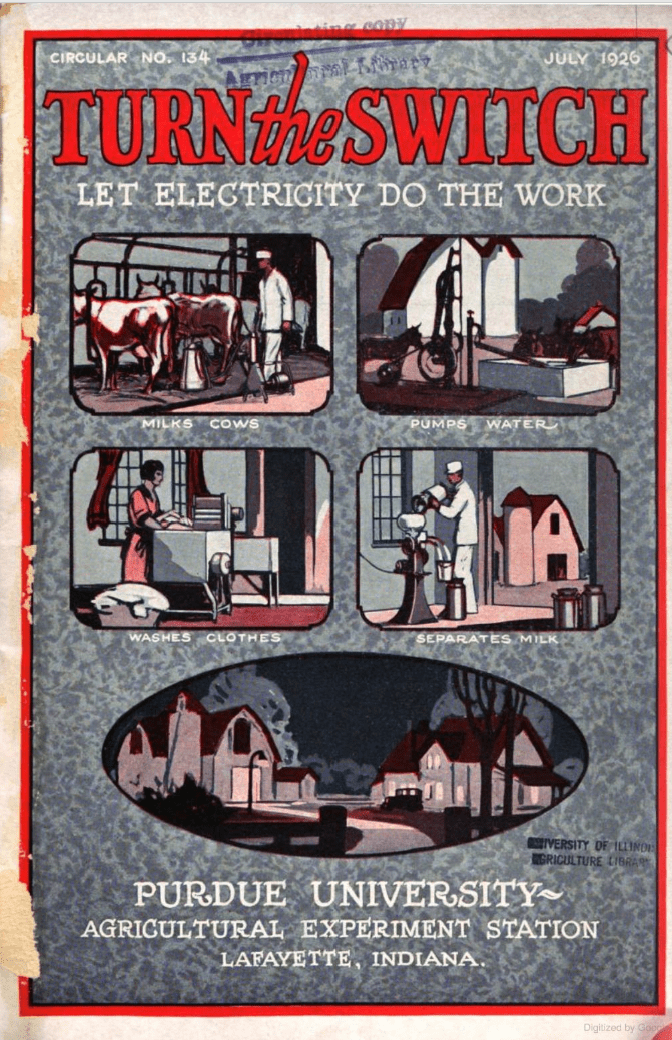
“Flip the Switch: Let Electricity Do The Work” reads this 1926 periodical. But who really benefits from labor-saving tech?
We already save so many hours: not going to the well to fetch water, milking cows, riding horseback, washing clothes by hand, etc. What are we doing with that time?
The problem is that at most jobs, the value of labor is disconnected from productivity. Labor is a commodity that employers purchase on the labor market. But what happens if the price of most labor falls to near zero?
Job Apocalypse
Jim Farley, CEO of Ford: AI could eliminate half of all white collar jobs in the US within the next decade.
Bill Gates, Co-Founder of Microsoft: Within 10 years humans won’t be needed for most things.
Elon Musk, CEO of Tesla: Probably none of us will have a job.
AI is not a labor-saving technological advancement, it’s labor-replacing.
Doesn’t that sound like a good thing potentially? Robots doing all the work so we can focus on our creative passions, hobbies, and families?
But Bernie asks:
Even if they’re only half right: What happens to the tens of millions of Americans who no longer have employment because they can’t find jobs that don’t exist? In this brave new world, how do Americans pay for health care, food, housing, and the other necessities of life?
The Impact of AI
The cotton gin didn’t end slavery in the US, that required a civil war.
I’m haunted by the historical precedent.
Imagine AI robots working 24/7: farming, building skyscrapers, and installing green energy infrastructure! We should be excited about AI’s potential to bring about the end of wage slavery and eliminate poverty.
But it’s dangerously naive to be optimistic given the current socio-political status quo. Debatably, humans already have the resources and ability to feed and house every person on Earth. So why does poverty still exist?
“Poverty creates the illusion that money is valuable, so that you work hard to obtain it. Poverty isn’t what you do to yourself, it’s what the powerful do to you.”
- Professor Jiang
The top 10% now hold 67.4% of all the wealth in the US. The bottom 50% hold 2.5%.
At what point will humanity stop letting the few, who reign like feudal lords, be the primary beneficiaries of advancements in tech?
Bernie says:
We do not simply need a more efficient society; we need a world where people live healthier, happier, and more fulfilling lives.
I hope we can all agree on that.
Part three is coming soon.